Tag: uw partnerships
The Morgridge Institute is deeply engaged with one of the world’s preeminent public research universities and work strategically with the biomedical research community at UW–Madison.

Weaving data and computing into a nationwide fabric supporting science
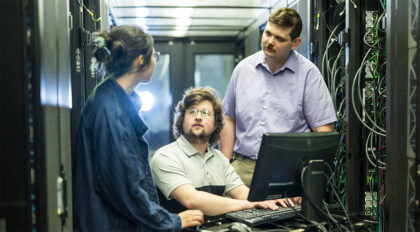
Building on decades of experience advancing research computing, the FabAID project is bringing high-throughput, data-intensive computing — and as many scientists as possible — into the age of AI.
-
Debilitating and rising form of heart failure is target of new multi-modal study
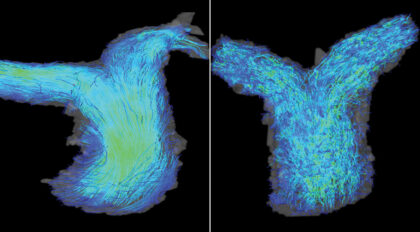
HFpEF is difficult for doctors to diagnose and determine which patients face the worst outcomes. A new study using imaging, invasive cardiac testing, and long-read RNA sequencing on biopsied heart tissue develops methods for clinicians to assess patient risk and builds an understanding of the mechanisms that underlie the condition.
-
NSF announces investment to shape the nation’s future data backbone
The National Science Foundation announced yesterday a five-year, $24.5 million award of the Fabric for AI-Driven Science (FabAID) led by the Morgridge Institute for Research. FabAID will build a fabric of services to accelerate data-intensive and AI-driven science.
-
New lab advance supercharges biotherapeutic development
Biotherapeutics, the fastest-growing segment of the pharmaceutical industry, could see another jolt of energy from a Wisconsin lab advance that accelerates a key drug development step by 100-fold.
-
Found in translation at HTC26: Throughput computing addresses new needs in AI, astrophysics
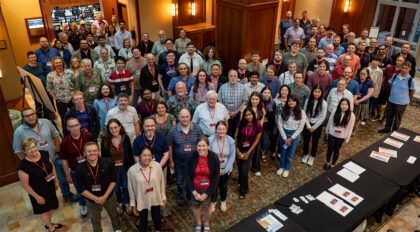
The fourth annual Throughput Computing Week brought an international research community to the University of Wisconsin–Madison campus on June 9-12 to assess challenges across science that demand a unique approach to computation.
-
SCI Lab: Finding common ground on divisive science
As a scholar on societal perceptions of scientific research, Dominique Brossard focuses a lot of energy on divisive, challenging and controversial topics. But her ultimate goal is to find the “rock” we all stand together on.
-
Congratulations to our 2026 graduates
More than 20 members of the Morgridge Institute community graduated with degrees from University of Wisconsin–Madison this year. A few reflect on their time at Morgridge and shout out their mentors. We wish all the 2026 grads the best of luck on their journeys ahead!
-
Science Expeditions Campus Open House brings STEM wonder to the whole family
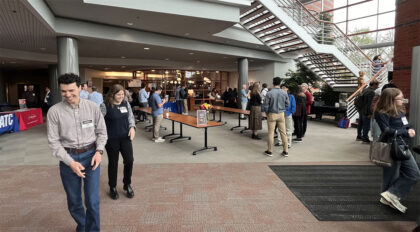
The Discovery Building and other venues across campus brought the magic of STEM discovery to visitors of all ages at Science Expeditions Campus Open House, a flagship spring event for science engagement.
-
Muscle matters: Highlights from the 20th annual Wisconsin Stem Cell Symposium
Regeneration research took center stage at the 20th annual Wisconsin Stem Cell Symposium, held April 15 just outside of Madison. An audience of 240 people heard from leaders in the field about promising steps towards regenerative medicine — and the burning basic science questions they’re still tackling.
-
The Art of Seeing More: A Fearless Science Forum
At “The Art of Seeing More” on March 10, a panel of experts came together for the Morgridge Institute’s Fearless Science Forum series to explore how scientists and artists challenge the limits of human perception.
-
When the box pushes back: Reflections on the spirit of resilience at Morgridge and WARF
Roma Broadberry has a unique perspective on Wisconsin science, as both a biophysics Ph.D. student in the Tim Grant Lab at Morgridge, and a WARF ambassador. Broadberry reflects on the resilience that helps both organizations thrive in challenging times.
-
Best of the Fest 2025: Wisconsin Science Festival in photos
We’ve collected some of our favorite moments from the 15th annual Wisconsin Science Festival. Which is your favorite?
-
Researchers look to advanced metabolic imaging to improve cancer immunotherapy
Researchers at the Morgridge Institute and UW–Madison are using advanced metabolic imaging to identify ways to improve CAR T cell therapy against solid tumors.
-
Advanced imaging highlights quick-changing act of innate immune cells
New research from the Melissa Skala Lab uses advanced metabolic imaging to study neutrophil metabolism in cell culture and a live zebrafish model.
-
Students envision their own futures in STEM at Summer Science Camp
The 19th annual Morgridge Summer Science Camp welcomed students from Wisconsin high schools for a week-long immersion into the world of science.
-
HTCondor celebrates 40 years powered by community
HTCondor celebrates 40 years of advancing science through a network of distributed computing power and a deeply engaged community.
-
For effective science communication, ‘just the facts’ isn’t good enough
Scientists who show humility and recognize that science “doesn’t have all the answers” will be more effective communicators with society, argues Morgridge PI Dietram Scheufele.
-
Throughput computing enables astronomers to use AI to decode iconic black holes
Scientists with the global Event Horizon Telescope project have learned new secrets about the black hole at the center of our Milky Way, with the help of high-throughput computing advances pioneered here in Wisconsin.
-
Congratulations to our 2025 graduates
Congratulations to our 2025 graduating students and research staff moving on into their next chapters. A few of them shared about their experiences at Morgridge and their plans for the future.
-
Researchers ‘seq’ and find a way to make pig retinal cells to advance eye treatments
For the first time, researchers developed stem cell-derived pig retinal cells in comparison with human retinal cells, envisioning a path to advance treatments for eye disease and injury.
-
New mass spec method gets the ‘nMOST’ out of multiomics data
The Coon Lab developed a new method to acquire multiomic data as quickly and as comprehensibly as possible, while keeping the system simple and accessible for anyone to use.
-
Mass spec fueling new explorations at the Carbone Cancer Center
Every cell has about 20,000 proteins, several hundred metabolites, and couple of thousand lipids. When those things get perturbed, bad things can happen. But measuring those changes may offer essential clues for fighting cancer.
-
From ‘blobology’ to atomic precision: Wisconsin’s leadership on cryo-EM imaging
Wisconsin is now an established national leader in cryo-electron microscopy, or cryo-EM, thanks to a decade-long strategic push from the UW–Madison biochemistry department and the Morgridge Institute.
-
High-throughput computing: Fostering data science without limits
HTCondor is gaining adherents across UW because scientists are learning that it is more than someone asking, “What technology do you need?” Research computing is a collaboration, and the people HTC brings to the equation are more important than the technology.
-
The Morgridge Metabolism Initiative: A blueprint for collaboration
The Morgridge Metabolism Initiative helps hundreds of campus scientists learn from each other and push the boundaries of research that is central to human health questions such as aging, diabetes and cancer.
-
Developing the science of science communication
The Morgridge Institute and UW–Madison Life Sciences Communication will join forces to investigate new ways to best communicate complex scientific topics to society.
-
Training the next generation of science leaders at Morgridge
Scientific training is much more than learning experimental methods or interpreting data. Trainees must practice management, leadership, collaboration, and communication skills to be successful and the Morgridge Institute is committed to fostering growth of “whole scientists” who are prepared to lead.
-
A research partnership brings gene editing promise to eye disease
One of the first frontiers of CRISPR gene editing is targeting diseases related to the eye. A diverse Morgridge and UW–Madison team is working to make future applications precise, safe and reproducible.
-
Hunting viral variants across Wisconsin, powered by high-throughput computing
When dangerous COVID viral variants were sweeping the globe, David O’Connor was busy tracking their spread in Wisconsin. His secret weapon? High-throughput computing.
-
Building a better bioimaging community: Chan Zuckerberg Initiative supports international partnership
Investigator Kevin Eliceiri leads a grant with BioImaging North America, which was recently awarded $1.2 million in funding from the Chan Zuckerberg Initiative.
-
National Science Foundation establishes a partnership to advance throughput computing
Morgridge and UW–Madison are partners on a $22.5 million project from the National Science Foundation to advance high-throughput computing technology and promote usage nationwide.
-
New national imaging center has potential to transform medicine
A national research initiative announced today will place the University of Wisconsin–Madison at the forefront of a revolution in imaging fostered by cryo-electron microscopy and cryo-electron tomography.
-
Rural Summer Science Camp expands opportunities, curriculum in its 13th year
The Morgridge Rural Summer Science Camp, where rural high school students and teachers take a deep dive into science research over the course of a week, is expanding and offering a third week of camp thanks to new support from a National Science Foundation (NSF) project.
-
Morgridge, campus partner to power up ‘mass spec’ potential
The Morgridge Institute for Research, as part of its Metabolism Initiative, is working with a University of Wisconsin–Madison team to greatly expand the scope of “mass spec” applications on campus. A new resource housed in the UW–Madison Biotechnology Center brings together a multi-million dollar investment in mass spectrometry tools from multiple sources to form a central repository to tackle large-scale investigations.
-
Morgridge Institute launches new focus area on metabolism
The Board of Trustees of the Morgridge Institute for Research has approved a new Morgridge focus area in metabolism, a growing research field with enormous potential to treat or reverse a broad spectrum of human diseases.